How Much Does Dental Treatment Cost in Japan? (2026 Price Guide)
With insurance, a Japanese dental checkup can cost less than lunch; without it, premium cosmetic work runs into hundreds of thousands of yen. Here are realistic 2026 price ranges so you can budget with confidence.
Dental prices in Japan depend on one big factor: whether the treatment is covered by national health insurance (you pay ~30%) or done privately (you pay 100%). The numbers below are typical ranges for 2025–2026; your actual cost varies by clinic, region, materials, and the complexity of your case. Always ask for an estimate before major work.
Insured treatment — what you actually pay (30%)
These are your out-of-pocket amounts with health insurance. Treatment is often spread over several visits, so these may be split across appointments.
| Treatment | Typical out-of-pocket (with insurance) |
|---|---|
| First visit: exam + X-ray | ¥3,000 – ¥5,000 |
| Follow-up visit | ¥1,000 – ¥3,000 |
| Simple cavity filling | ¥1,500 – ¥4,000 |
| Scaling / gum cleaning | ¥1,000 – ¥3,500 per visit |
| Root canal (per tooth, total) | ¥6,000 – ¥15,000 over several visits |
| Standard crown (metal / CAD-CAM) | ¥3,000 – ¥10,000 |
| Tooth extraction (simple) | ¥1,500 – ¥4,000 |
| Wisdom tooth extraction | ¥1,500 – ¥6,000 (more if surgical) |
| Standard partial denture | ¥5,000 – ¥15,000 |
Private / cosmetic treatment — full price (no insurance)
These treatments aren't covered, so you pay the clinic's full rate. Prices vary widely between clinics and cities; premium clinics in central Tokyo sit at the top of these ranges.
| Treatment | Typical full price |
|---|---|
| In-office teeth whitening | ¥30,000 – ¥80,000 |
| Home whitening kit | ¥20,000 – ¥45,000 |
| Ceramic crown (per tooth) | ¥80,000 – ¥180,000 |
| Porcelain veneer (per tooth) | ¥80,000 – ¥150,000 |
| Dental implant (per tooth, all-in) | ¥300,000 – ¥600,000 |
| Full braces (orthodontics) | ¥600,000 – ¥1,000,000+ |
| Invisalign (clear aligners) | ¥400,000 – ¥1,000,000 |
| Cosmetic cleaning / PMTC | ¥5,000 – ¥15,000 |
Want the detail behind a single number? See our dedicated guides to dental implants, crowns and dentures — each breaks down the insured vs. private choice for that treatment.
Why a checkup can be so cheap
Insured fees are set nationally, so a covered exam costs roughly the same everywhere. With the 70% insurance subsidy, your share for a basic visit is small — which is why dentists in Japan are accessible even on a modest budget. The flip side is that cosmetic work, set freely by each clinic, can be expensive.
Hidden costs and money tips
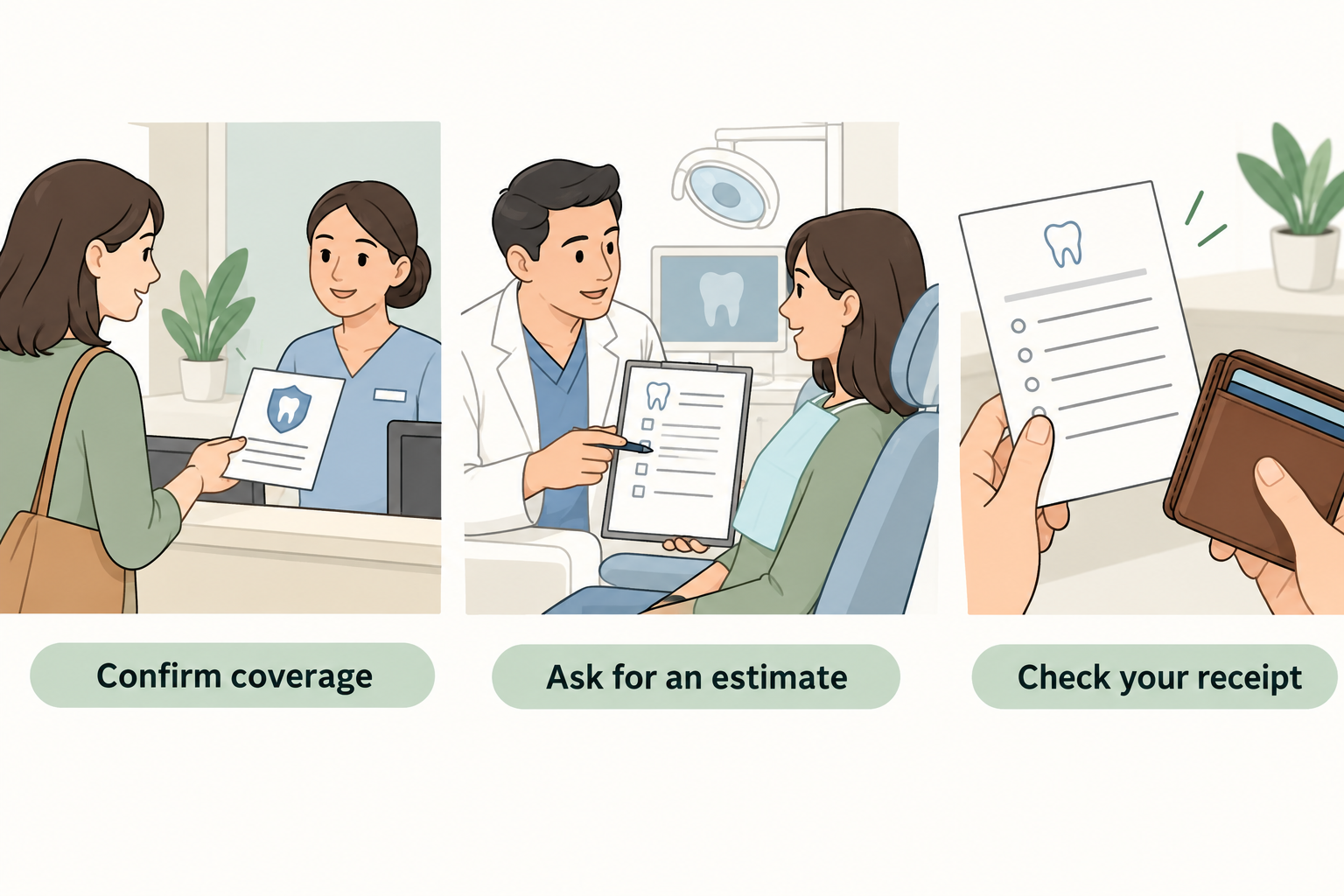
- Bring your insurance card every time. Forget it and you pay 100% up front (you can sometimes claim the difference back later with the receipt — but it's a hassle).
- Cash is king. Many smaller clinics don't take cards. Bring cash, especially for a first visit.
- First visits cost more than follow-ups because of the initial exam and X-rays.
- Ask for a written estimate (見積もり) before any private work. For implants or orthodontics, get the all-in figure including follow-ups.
- Insured vs. private materials can change a crown's price tenfold. Ask which option you're being quoted.
- Payment plans are common for big cosmetic cases — ask about installments (分割払い).
Sample budgets
Routine year (insured resident): Two checkups/cleanings plus one small filling ≈ ¥8,000–¥15,000 total out of pocket.
One problem tooth (insured): Root canal + standard crown ≈ ¥10,000–¥25,000 across several visits.
Cosmetic smile upgrade (private): Whitening plus a couple of ceramic crowns ≈ ¥200,000–¥450,000.
How insured dental fees are calculated
Insured dental prices in Japan aren't set by each clinic — they follow a nationally fixed points system (点数). Every covered procedure is assigned a set number of points, each point is worth ¥10, and the total is calculated from the points, after which you pay your 30% share. This is why a covered filling or checkup costs roughly the same whether you go to a clinic in central Tokyo or rural Kyushu, and why your bill is itemized on a printed receipt (明細書). It also explains the multi-visit pattern: certain procedures can only be billed in defined steps, so treatment is paced accordingly. The upside for you is predictability — covered care is standardized and transparent, and you can ask the clinic to walk you through the itemized receipt if a charge is unclear.
Practical ways to keep dental costs down
You can manage your spending without compromising care. The single biggest saver is prevention: a ¥2,000 filling caught early beats a ¥20,000-plus root canal and crown later, so regular checkups genuinely pay for themselves. Always bring your insurance card to claim the 30% rate. When offered a choice, ask whether an insured option exists before agreeing to a private crown or inlay — for back teeth, the covered version is often perfectly good. Confirm the clinic accepts insurance before booking, since private-only clinics charge full price even for basics. For big cosmetic work, get multiple estimates and ask about installment plans (分割払い). And keep all receipts: if your household's total annual medical and dental spending is high, you may be able to claim a medical expense deduction (医療費控除) on your income tax, recovering part of the cost.
Bottom line
Necessary dental care in Japan is genuinely affordable with insurance, while cosmetic work is a significant investment. Confirm whether your treatment is insured, ask for estimates on anything private, and carry your insurance card and cash. If cost is a concern, a matching service can help you find a clinic that accepts insurance and fits your budget.
Frequently Asked Questions
How much is a dental checkup in Japan with insurance?
Usually around ¥3,000–¥5,000 for a first visit including an exam and X-ray, and less for follow-ups. Without insurance you'd pay the full amount, often ¥8,000 or more.
Why are implants and whitening so expensive in Japan?
They're not covered by health insurance because they're considered elective or cosmetic, so you pay the clinic's full private rate. Implants also involve surgery, premium materials and multiple visits, which adds up to ¥300,000–¥600,000 per tooth.
Can I pay by credit card at a Japanese dentist?
Some clinics accept cards, especially larger or international-facing ones, but many smaller practices are cash-only. Bring cash for your first visit and ask in advance if you want to pay by card.
Need an English-speaking dentist? We'll find one — free.
Tell us your area, language, and the treatment you need. We match you with the right clinic and make the booking call for you, in your language.
This article is general information for foreigners living in or visiting Japan, not medical or financial advice. Prices are typical 2025–2026 ranges and vary by clinic, region, and your specific case; insurance coverage depends on your enrollment and the treatment. Always confirm details directly with the clinic.