Does Japanese Health Insurance Cover Dental Treatment?
Yes — Japanese health insurance covers most necessary dental treatment, and you usually pay just 30%. But cosmetic and premium options are never covered. Here's exactly where the line falls.
One of the best surprises for foreigners in Japan is that dental care is included in the same national health insurance that covers doctors and hospitals. There's no separate "dental plan" to buy, the way there often is abroad. If you're enrolled in Japanese public insurance, you're already covered for the dentistry that matters most.
How the coverage works
Japan's public health insurance — National Health Insurance (国民健康保険) for the self-employed and many residents, or Employees' Health Insurance (社会保険) through your workplace — covers medically necessary dental treatment. For most working-age adults, insurance pays 70% and you pay the remaining 30% at the clinic. Children and older adults pay even less (often 10–20%).
This applies at any clinic that accepts insurance (保険診療, hoken shinryō) — which is the large majority. You simply show your insurance card at reception and the discounted rate is applied automatically.
What IS covered (you pay ~30%)
- Checkups and exams for a dental problem
- Cavity treatment and fillings (standard materials)
- Root canal treatment
- Standard crowns — metal, or tooth-colored plastic/CAD-CAM crowns on eligible teeth
- Tooth extractions, including most wisdom teeth
- Gum disease treatment — scaling, tartar removal, inflammation control
- Standard dentures and partial dentures
- Treatment-related X-rays and medication (antibiotics, painkillers)
- Basic cleaning when it's part of treating a condition like gum disease
What is NOT covered (you pay 100%)
Anything considered cosmetic, elective, or "premium" falls outside insurance and is billed at the clinic's own private rate:
- Teeth whitening — purely cosmetic, never covered
- Ceramic and porcelain crowns / veneers chosen for appearance on teeth where a standard option exists
- Dental implants (in almost all cases)
- Orthodontics — braces and Invisalign for ordinary alignment (rare medical exceptions exist)
- Premium dentures with non-standard materials
- Purely preventive cleaning with no diagnosed condition, at some clinics
The "insured vs. private" choice
For many treatments you'll be offered a choice. A back molar crown, for example, might be a covered metal or CAD-CAM crown (cheap, functional) or a private ceramic crown (natural-looking, stronger aesthetics, several times the price). Both are legitimate — it's your call based on budget and how visible the tooth is. A good dentist will explain both.
| Treatment | Insured option | Private option |
|---|---|---|
| Front tooth crown | Plastic-faced (covered) | All-ceramic (cosmetic, 100%) |
| Filling | Composite / metal (covered) | Ceramic inlay (100%) |
| Missing tooth | Bridge or denture (covered) | Implant (100%) |
| Cleaning | As gum treatment (covered) | Cosmetic polish / PMTC (100%) |
A caution about private-only clinics
Some clinics — often those marketing heavily to foreigners and tourists — operate entirely on a private-pay basis (自由診療, jiyū shinryō) and don't accept Japanese insurance at all. Their quality can be excellent, but you'll pay full price even for a basic filling. Always ask "Do you accept health insurance?" (保険は使えますか?) before booking if budget matters.
What about private dental insurance?
Because public insurance already covers necessities cheaply, most residents don't buy separate dental insurance. Some private medical insurance plans add limited dental riders, and a few employers offer supplemental coverage, but it's far less central than in countries without universal coverage. For big cosmetic work, people typically save or use clinic payment plans rather than insurance.
How to enroll and use your insurance card
To get the 30% rate, you first need to be enrolled. If you work for a company, you're typically on Employees' Health Insurance (社会保険) automatically through payroll. Everyone else — students, freelancers, many spouses and longer-term residents — enrolls in National Health Insurance (国民健康保険) at their city or ward office, usually within 14 days of moving in or changing status. You'll receive a health insurance card (保険証); from 2024–2025 Japan has also been linking insurance to the My Number Card, so in some clinics you can verify coverage with that instead. Either way, present your card at reception on every visit and the discount applies automatically.
If you visit a dentist before your card arrives, you may have to pay 100% temporarily; keep the receipt, because once enrolled you can often claim back the insured portion. Don't let a pending card stop you from treating real pain — but do enroll promptly, because uninsured dental bills add up fast.
Covered vs. not covered: quick real examples
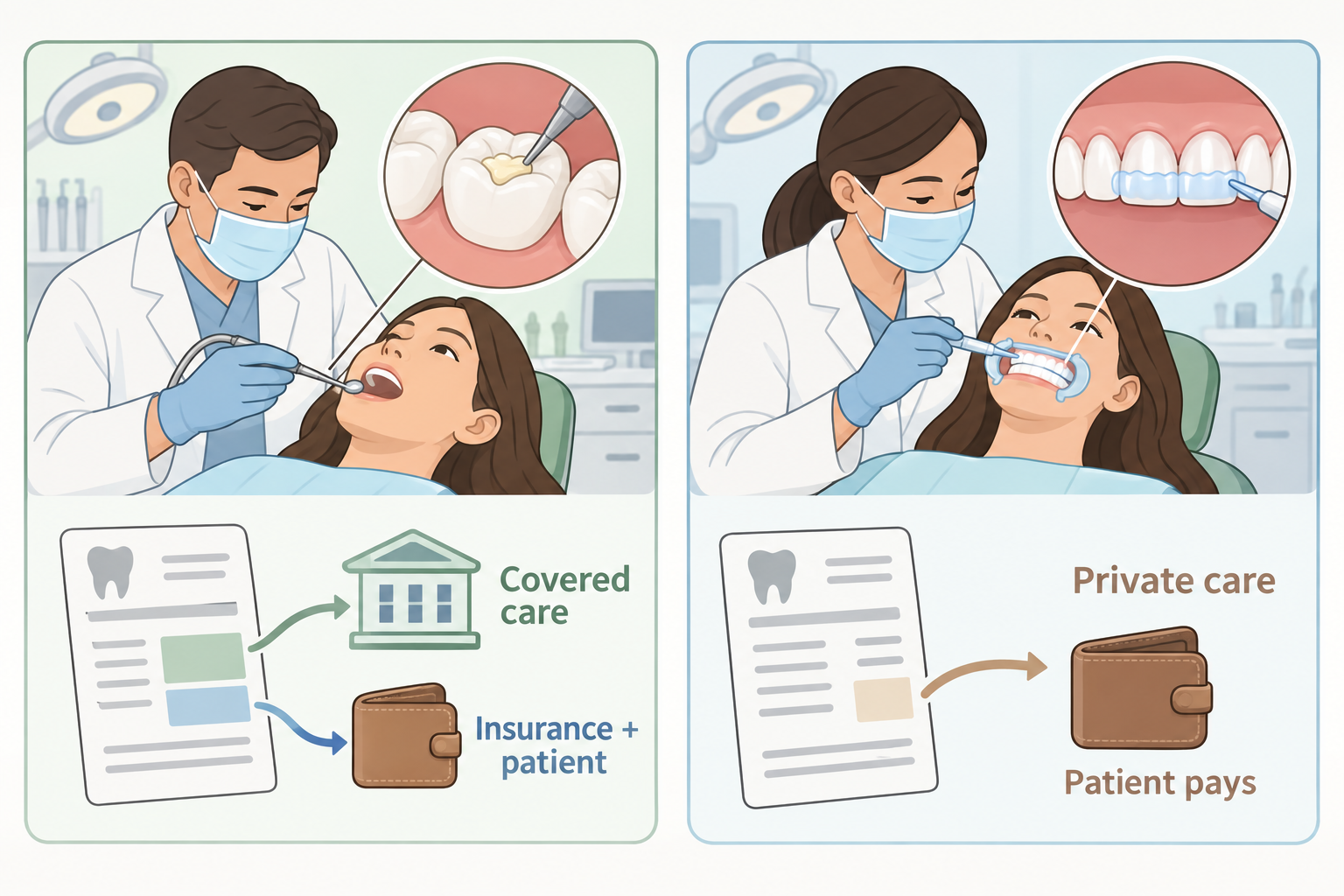
It helps to see the principle in action. A back molar with a cavity, filled with composite resin and capped with a metal crown — covered. The same molar capped with a zirconia crown you chose for looks — the crown is private. A deep cavity needing a root canal — covered; whitening the rest of your smile at the same visit — private. A missing tooth replaced with a standard bridge or denture — covered; replaced with an implant — private. Scaling to treat bleeding, inflamed gums — covered; a purely cosmetic polish with no diagnosis — possibly private. The recurring logic: restoring health and function with standard methods is covered; upgrading for appearance or choosing premium/elective options is not.
Bottom line
If you have Japanese health insurance, your essential dental care — cavities, root canals, extractions, standard crowns, gum treatment — is covered at about 30% of cost. Whitening, implants, braces and cosmetic upgrades are out of pocket. When in doubt, ask the clinic which parts of your plan are covered and which aren't, before treatment starts.
Frequently Asked Questions
Is dental included in normal Japanese health insurance or is it separate?
It's included. The same National Health Insurance or Employees' Health Insurance that covers doctors also covers necessary dental treatment — there's no separate dental plan to buy.
Why did my dentist charge full price for a crown?
You likely chose (or were given) a private ceramic crown, which is cosmetic and not covered, or you visited a private-only clinic. Ask in advance whether an insured option exists and whether the clinic accepts insurance at all.
Does insurance cover teeth cleaning in Japan?
Cleaning is covered when it's part of treating a diagnosed condition such as gum disease (scaling, tartar removal). A purely cosmetic or preventive polish with no diagnosis may be charged privately, depending on the clinic.
Need an English-speaking dentist? We'll find one — free.
Tell us your area, language, and the treatment you need. We match you with the right clinic and make the booking call for you, in your language.
This article is general information for foreigners living in or visiting Japan, not medical or financial advice. Prices are typical 2025–2026 ranges and vary by clinic, region, and your specific case; insurance coverage depends on your enrollment and the treatment. Always confirm details directly with the clinic.