Emergency Dental Care in Japan: What to Do for a Toothache at Night or on Weekends
Dental pain has a cruel habit of peaking at night or on a holiday, when your usual clinic is closed. Japan has real options for emergencies — here's how to get help fast, even after hours.
A throbbing tooth, sudden swelling, a knocked-out tooth, or a lost filling can't always wait for Monday. Japan's regular dental clinics keep limited hours, but the country has emergency and after-hours systems if you know where to look. Act calmly and use the right channel for your situation.
First, gauge how urgent it is
| Situation | What to do |
|---|---|
| Knocked-out adult tooth | Act within 30–60 min. Find emergency care immediately (see below). |
| Severe swelling of face/jaw, fever, trouble swallowing or breathing | Medical emergency. Call #7119 or 119 for an ambulance — this can be a spreading infection. |
| Severe, unrelenting toothache | Seek same-day/after-hours dental care; manage pain meanwhile. |
| Lost filling/crown, chipped tooth, mild ache | Usually can wait a day or two; book your regular clinic. |
Where to get after-hours dental care
1. Holiday & Sunday emergency dental clinics (休日急患歯科)
Most prefectures and large cities run emergency dental clinics on Sundays and public holidays, coordinated by the local dental association (歯科医師会, shika ishikai). Hours are typically daytime (e.g., 9:00–17:00). Search your city name plus "休日 歯科 急患" or check your city/ward website's medical section.
2. Late-night clinics in big cities
In Tokyo and other major cities, some private clinics stay open late — occasionally past midnight — and accept emergencies and walk-ins, with English-friendly options near major stations like Shibuya and Roppongi. These are usually private-pay and pricier, but invaluable at 2am.
3. University dental hospitals
Large teaching hospitals such as Tokyo Medical and Dental University and Osaka University Dental Hospital accept emergency walk-ins, including on weekends. They handle complex cases and often have some English capacity.
4. The #7119 emergency consultation line
In Tokyo and many regions you can dial #7119 for 24/7 medical advice — they'll tell you whether to call an ambulance, go to an emergency room, or wait for a clinic, and can point you to open facilities. Some areas offer English support. (Coverage varies by region; if #7119 doesn't work, search your prefecture's emergency medical info line.)
First aid while you wait
- Pain: Take an over-the-counter painkiller you normally tolerate (e.g., ibuprofen/Loxonin from a pharmacy). Follow the label.
- Swelling: A cold compress on the cheek can ease pain and swelling.
- Knocked-out tooth: Hold it by the crown (not the root), rinse gently, and if possible reinsert it into the socket. If not, keep it in milk or your own saliva — not water — and get to a dentist fast.
- Lost filling/crown: Keep the crown if you have it. Temporary dental cement from a pharmacy can hold it briefly. Avoid chewing on that side.
- Bleeding after extraction: Bite firmly on clean gauze for 20–30 minutes; avoid rinsing hard, smoking or alcohol.
The language barrier in an emergency
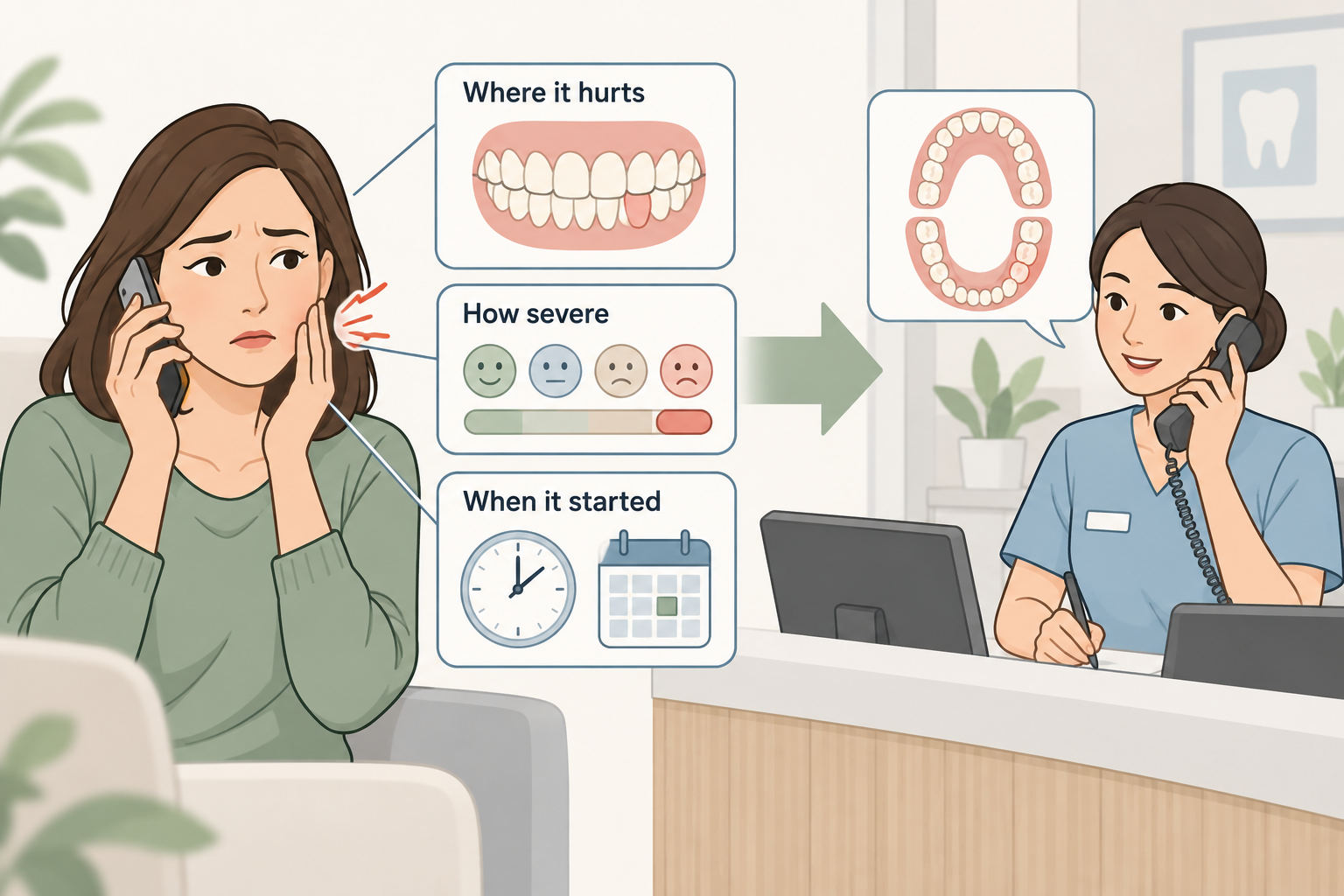
Pain plus a foreign-language phone tree is rough. Keep these phrases handy: 歯が痛いです (ha ga itai desu — my tooth hurts), とても痛いです (totemo itai desu — it hurts a lot), 今日診てもらえますか?(kyō mite moraemasu ka? — can I be seen today?). A translation app and a willingness to point at the tooth go a long way. If you have time, a foreigner-focused service can locate an open, English-friendly clinic and call ahead for you.
Prevent the 2am panic
The best emergency plan is not needing one. Get regular checkups so small problems are caught early, know your nearest clinic's hours and closed day, and save an emergency contact (your clinic, #7119, and a booking service) in your phone before you need it.
Useful Japanese for a dental emergency
| English | Japanese | Pronunciation |
|---|---|---|
| It's an emergency. | 緊急です。 | kinkyū desu |
| I'm in a lot of pain. | とても痛いです。 | totemo itai desu |
| Can you see me today? | 今日診てもらえますか? | kyō mite moraemasu ka? |
| My face is swollen. | 顔が腫れています。 | kao ga harete imasu |
| My tooth was knocked out. | 歯が抜けました。 | ha ga nukemashita |
| Is there a dentist open now? | 今開いている歯医者はありますか? | ima aite iru haisha wa arimasu ka? |
What an emergency visit can and can't do
After-hours and holiday emergency care is about relief and stabilization, not finishing your treatment. The on-call dentist will typically control your pain, drain or settle an infection (sometimes with antibiotics), reattach or temporarily patch a lost filling or crown, stop bleeding, or stabilize a knocked-out or broken tooth. Definitive work — the permanent crown, the full root canal, the implant — is then completed later at a regular clinic, ideally your own. So expect the emergency visit to get you out of pain and through the night or weekend, with a recommendation to follow up promptly. Bring your insurance card if you can (emergency clinics often accept it), and keep any receipts, especially if you're a visitor claiming on travel insurance.
What to have ready before an emergency strikes
Five minutes of preparation now saves panic later. Save your regular clinic's number and hours, the #7119 line (or your prefecture's emergency medical info number), and a booking-support contact in your phone. Note your nearest hospital with a dental or oral-surgery department. Keep a small kit at home: an over-the-counter painkiller you tolerate, dental wax or temporary filling cement from a pharmacy, and clean gauze. Know where your insurance card is. If you have a knocked-out tooth, remember the milk trick — and that time matters. None of this is hard, but having it sorted means that when pain hits at 2 a.m., you act instead of scramble.
Bottom line
For true medical emergencies — big swelling, fever, breathing trouble — call #7119 or 119. For after-hours dental pain, use holiday/Sunday emergency dental clinics, late-night clinics in big cities, or a university dental hospital. Manage pain safely while you arrange care, and keep your emergency contacts saved in advance.
Frequently Asked Questions
What number do I call for a dental emergency in Japan?
In Tokyo and many regions, dial #7119 for 24/7 medical guidance (some areas offer English). For life-threatening symptoms like breathing difficulty or rapidly spreading facial swelling, call 119 for an ambulance. Coverage of #7119 varies by region, so also check your prefecture's emergency medical line.
Are there 24-hour dentists in Japan?
True 24-hour dental clinics are rare, but some private clinics in big cities like Tokyo stay open very late, sometimes past midnight, and accept emergencies. Prefectures also run Sunday and holiday emergency dental clinics during daytime hours, and university dental hospitals take weekend walk-ins.
What should I do if my tooth gets knocked out?
Pick it up by the crown, not the root, rinse it gently, and try to place it back in the socket. If you can't, keep it in milk or your saliva (never plain water) and get to a dentist within 30–60 minutes for the best chance of saving it.
Need an English-speaking dentist? We'll find one — free.
Tell us your area, language, and the treatment you need. We match you with the right clinic and make the booking call for you, in your language.
This article is general information for foreigners living in or visiting Japan, not medical or financial advice. Prices are typical 2025–2026 ranges and vary by clinic, region, and your specific case; insurance coverage depends on your enrollment and the treatment. Always confirm details directly with the clinic.