What to Expect at Your First Dental Appointment in Japan
Walking into a Japanese dental clinic for the first time can feel daunting if you don't know the routine. Here's exactly what happens, step by step, so you arrive prepared and relaxed.
Your first visit (初診, shoshin) sets up everything that follows — your records, your treatment plan, and your relationship with the clinic. Knowing the flow in advance removes most of the stress, especially when there's a language barrier.
Before you go
Book ahead
Almost all clinics require an appointment. Call, book online, or use a booking-support service. Mention it's your first visit and describe your symptom so they allocate enough time.
What to bring
- Health insurance card (保険証) — without it you pay 100%.
- Photo ID (residence card or passport).
- Cash — at least ¥5,000; first visits cost more due to exams and X-rays, and many clinics are cash-only.
- Medication list / allergies — bring your okusuri techō if you have one.
- Any past dental records or X-rays, if continuing treatment from abroad.
Arrive 10–15 minutes early to fill out paperwork.
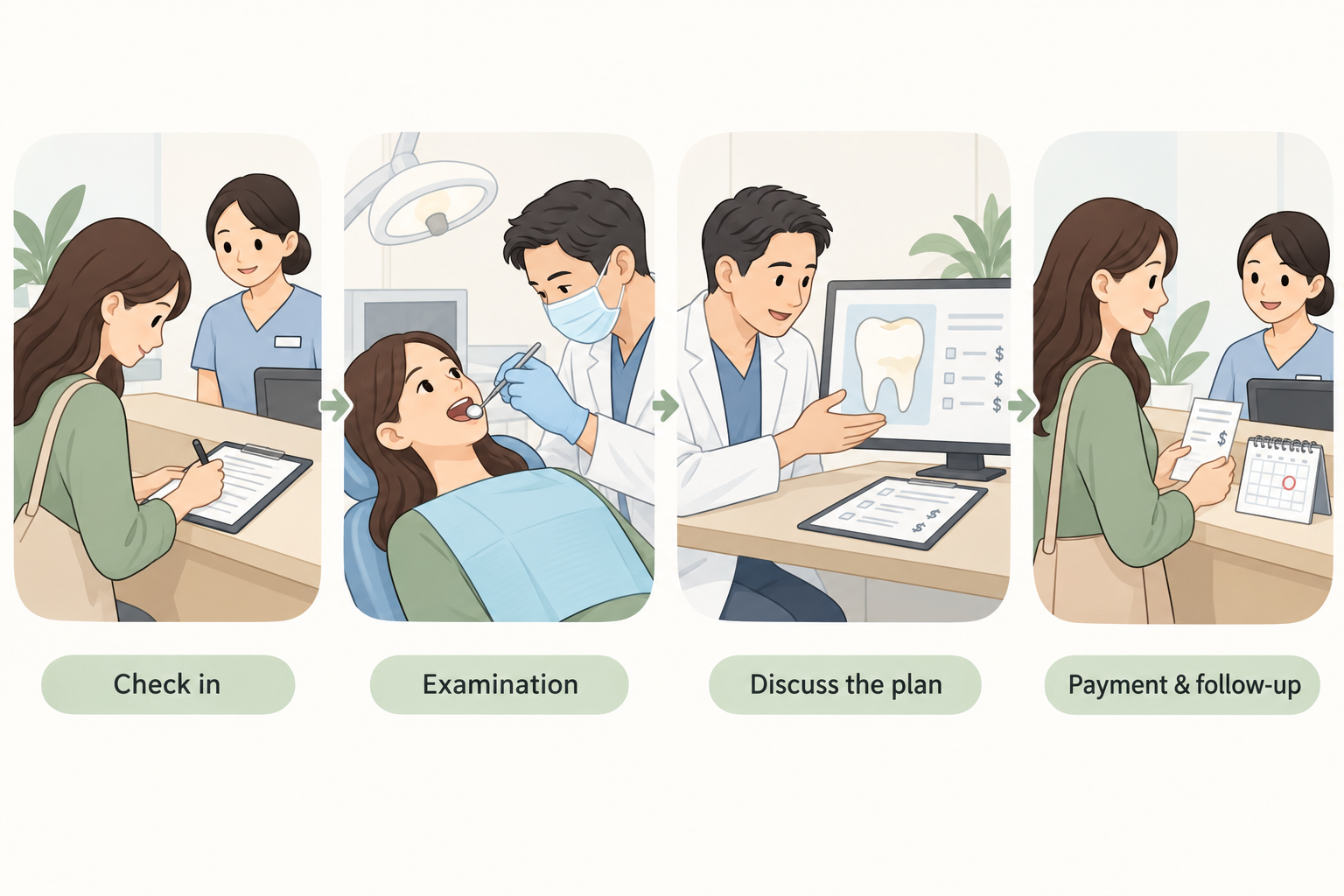
Step 1: Check-in and paperwork
At reception you'll hand over your insurance card and fill out a medical questionnaire (問診票, monshinhyō). It asks about your symptoms, medical history, medications, allergies, and what's bothering you today. Many clinics now have English forms — ask, or fill it in with a translation app. Be honest about heart conditions, pregnancy, blood thinners and allergies; these affect anesthesia and treatment.
Step 2: The exam
A dental assistant or hygienist usually seats you and confirms your concern. The dentist then examines your teeth and gums, often using a small mirror and probe. Expect an X-ray — it's standard even at a checkup and helps the dentist see decay, infection or bone issues that aren't visible.
Step 3: Explanation and plan
The dentist explains what they found and proposes a treatment plan. This is your moment to ask:
- What's the problem, and what are my options?
- Is this covered by insurance, or private-pay?
- How much will it cost, and how many visits?
- What happens if I wait?
If anything is unclear, ask them to explain in simple Japanese (簡単な日本語で), use the clinic's English support, or your translation app. Don't agree to expensive private treatment you don't fully understand.
Step 4: First treatment (maybe)
For urgent pain, the dentist may start treatment immediately — for example, cleaning out a cavity or relieving an infection. For non-urgent or complex cases, the first visit might be exam-and-plan only, with treatment beginning next time. Remember, Japanese clinics often spread treatment over several short visits; this is normal.
Step 5: Payment and next booking
You pay the day's portion at reception. With insurance, a first visit commonly runs ¥3,000–¥5,000. You'll usually book your next appointment before leaving, and may receive a clinic card (診察券, shinsatsuken) to bring each time.
Handling the language barrier
Three things make a first visit go smoothly even with limited Japanese: type your symptoms into a translation app before you arrive; learn a few core phrases (歯が痛いです — "my tooth hurts"; 保険は使えますか? — "is it covered by insurance?"); and choose a clinic with English support or book through a matching service that confirms it. Dentistry is visual, so the X-ray and the dentist's screen will show you most of what's happening.
Cultural notes
Clinics are calm and punctual. You may sanitize your hands on entry, and some older clinics ask you to change into slippers. Staff are polite and process-oriented; a brief, clear description of your problem is appreciated. Tipping is not a thing in Japan — never necessary at a clinic.
How long will the first visit take?
Plan for about 30 to 60 minutes for a first visit, including paperwork, the exam, an X-ray and the dentist's explanation — longer if urgent treatment starts the same day. Arrive 10–15 minutes early to complete the questionnaire. Keep in mind that booked appointment times are taken seriously in Japan; clinics run on schedule, so being late can mean a shortened slot or rebooking. If you're squeezed in as an emergency walk-in, expect to wait longer between steps while the clinic fits you around its booked patients.
Common worries foreigners have (and the reality)
A few anxieties come up again and again. "Will they judge my teeth?" — No; dentists see everything and are matter-of-fact, not critical. "Will it be painful?" — Local anesthesia is standard for anything that would hurt; just ask for it (麻酔をお願いします). "Will they do unnecessary work to charge me?" — Insured fees are nationally fixed and modest, so there's little incentive to over-treat covered work; for private work, you can always decline or get a second opinion. "What if I don't understand the consent form?" — Don't sign anything you don't understand; ask for a simple explanation, use a translation app, or reschedule with language support for big decisions. "Can I bring someone?" — Yes, a friend or interpreter is welcome, especially for complex visits.
Building a relationship with your clinic
Your first visit is the start of an ongoing relationship, not a one-off. After it, you'll usually receive a clinic card (診察券) to bring each time, and the clinic keeps your records and X-rays. Returning to the same dentist means they already know your history, your anxieties and your previous work, which makes every future visit faster and more comfortable. If the first clinic isn't a good fit — language, manner, or pricing — it's perfectly fine to try another; nothing obligates you to stay. Many foreigners find that once they've settled on a clinic they trust, the dentist becomes one of the easiest parts of life in Japan.
Bottom line
Bring your insurance card, ID and cash; expect paperwork, an exam and an X-ray; ask about cost and coverage before agreeing to treatment; and don't be surprised if treatment is staged over several visits. Prepared and with a little language help, your first Japanese dental visit is genuinely easy.
Frequently Asked Questions
How much should I bring to my first dental visit in Japan?
Bring at least ¥5,000 in cash. A first visit with an exam and X-ray typically costs ¥3,000–¥5,000 with insurance, and many clinics don't accept cards.
Will they take an X-ray on the first visit?
Usually yes. An X-ray is standard even for a routine checkup because it reveals decay, infection and bone problems the dentist can't see directly. It's included in your insured fee.
What if I don't speak Japanese at my first appointment?
Type your symptoms into a translation app before you go, learn a few key phrases, and choose a clinic with English support or book through a service that confirms it and handles the call. Pointing to the painful tooth and rating pain 1–10 also helps a lot.
Need an English-speaking dentist? We'll find one — free.
Tell us your area, language, and the treatment you need. We match you with the right clinic and make the booking call for you, in your language.
This article is general information for foreigners living in or visiting Japan, not medical or financial advice. Prices are typical 2025–2026 ranges and vary by clinic, region, and your specific case; insurance coverage depends on your enrollment and the treatment. Always confirm details directly with the clinic.