Going to the Dentist in Japan: A Complete Guide for Foreigners
If you live in or are visiting Japan, going to the dentist is easier and cheaper than many newcomers expect — once you understand how the system works. Here's the complete picture, start to finish.
Japan's dental system is high quality, widely accessible, and — for insured residents — surprisingly affordable. The main hurdles for foreigners are the language barrier and a few cultural differences in how treatment is delivered. This guide covers the whole journey so you know what to expect before you sit in the chair.
The basics: how dental care works in Japan
Most dental clinics in Japan are small, private practices ("medical corporations") rather than parts of big hospitals. They're typically open on weekdays plus Saturday mornings, often closed Wednesdays or Sundays, and almost always run on appointments. Standards are high, equipment is modern, and infection control is strict.
If you're enrolled in Japanese health insurance — National Health Insurance (国民健康保険) or Employees' Health Insurance (社会保険) — most necessary dental treatment is covered, and you pay only 30% of the cost. That's what makes routine care so affordable.
What you'll pay
With insurance, a first visit with an exam and X-ray often runs around ¥3,000–¥5,000. A simple insured filling might be ¥1,500–¥3,000 out of pocket. Treatment is usually split across several short appointments, so costs are spread out. Cosmetic and premium options — whitening, ceramic crowns, implants, orthodontics — are not covered and are paid fully out of pocket. We cover pricing in detail in our dental cost guide.
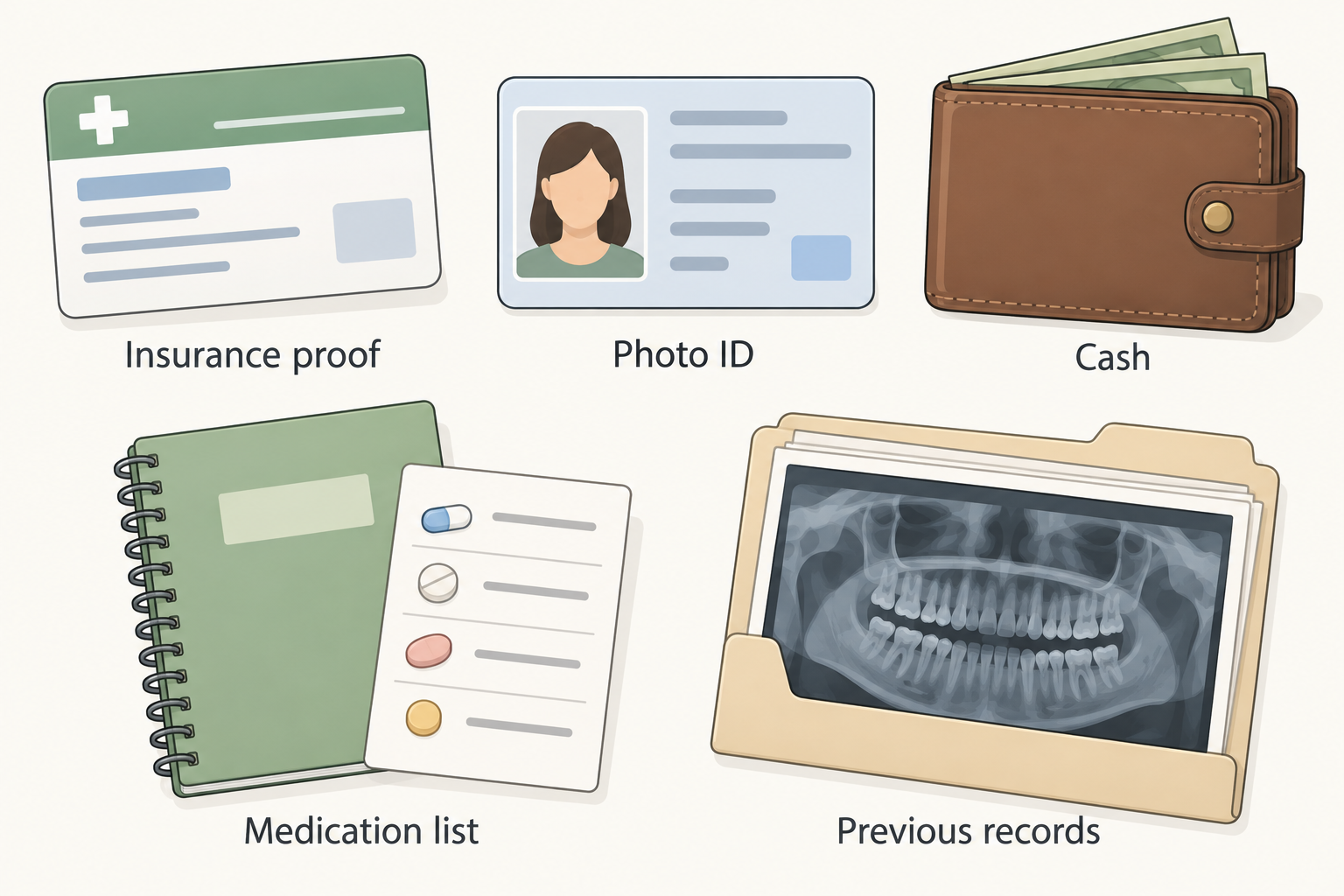
Before your visit: what to bring
- Health insurance card (保険証, hokenshō) — essential to get the 30% rate. Without it you pay 100% up front.
- Photo ID (residence card or passport).
- Cash — many clinics are cash-only or prefer cash; bring at least ¥5,000 for a first visit with X-rays.
- A list of medications you take, and any allergies. Your okusuri techō (medication notebook) is ideal.
- Any previous X-rays or records if you're continuing treatment from another country.
Making the appointment
Most clinics take bookings by phone; a growing number use online reservation systems or LINE. If you don't speak Japanese, a few key phrases or a free booking-support service makes this painless. Tell them your symptom, whether it's your first visit (初診, shoshin), and your preferred day and time. Walk-ins are sometimes accepted for emergencies but not guaranteed.
At the clinic, step by step
- Check in at reception and hand over your insurance card. First-timers fill out a medical questionnaire (問診票) about symptoms, health history and medications.
- Exam and X-ray. The dentist examines the problem tooth and usually takes an X-ray, even at a checkup.
- Explanation. The dentist explains what they found and proposes a treatment plan. Ask for the cost and number of visits here.
- Treatment. For anything beyond a quick fix, treatment is typically spread across multiple appointments — this is normal in Japan, not a delay tactic.
- Pay and rebook. You settle the day's portion at reception and usually book your next visit before leaving.
Cultural differences foreigners notice
Treatment is split into many short visits
Where a dentist abroad might do everything in one long appointment, Japanese clinics often book several 15–30 minute visits. This keeps each insured procedure within set fee rules and lets the dentist check healing between steps. It can feel slow, but it's standard.
Cleanings may be staged too
A thorough insured scaling/cleaning is sometimes done over two or more visits, especially if there's gum inflammation. A hygienist often performs the cleaning and gives brushing guidance.
Detailed explanations and consent
Clinics increasingly explain options and get your consent, particularly for crowns, extractions and anything private-pay. Don't hesitate to ask questions — a good clinic welcomes them.
Mask, shoes and quiet
You may be asked to use hand sanitizer on entry. Some older clinics ask you to change into slippers. Waiting rooms are usually calm and quiet.
Emergencies and after-hours care
For sudden severe pain, swelling, or a knocked-out tooth, most areas have emergency dental clinics on Sundays and holidays run by the local dental association, and some big cities have late-night dental clinics. You can also dial #7119 in many regions for medical guidance. We cover this fully in our emergency dental guide.
If you're not enrolled in insurance yet
Residents staying more than three months are generally required to enroll in National Health Insurance at their city office — do it soon after arrival, because it dramatically lowers dental (and all medical) costs. Tourists and short-term visitors won't have Japanese insurance and will pay private rates, so travel insurance with dental coverage is worth checking.
Who's who at a Japanese dental clinic
Understanding the team helps you know who to ask for what. The dentist (歯科医師, shika ishi) diagnoses and performs treatment. The dental hygienist (歯科衛生士, shika eiseishi) handles cleanings, scaling, fluoride and brushing guidance — in Japan, hygienists do a lot of the preventive work and you'll often see them more than the dentist. Dental assistants support during procedures and seat you, and reception staff (受付) handle bookings, your insurance card and payment. At larger clinics you may also encounter specialists in orthodontics (矯正歯科), pediatric dentistry (小児歯科) or oral surgery (口腔外科). If your case is complex, a general clinic may refer you to a specialist or a university dental hospital — a normal part of the system, not a sign something is wrong.
Tips to make every visit smoother
A few habits make Japanese dental visits noticeably easier. Keep your insurance card and clinic card (診察券) together so you never forget them — forgetting the insurance card means paying full price that day. Arrive a few minutes early; clinics run on tight, punctual schedules. If you're continuing treatment, bring any prior estimates or notes so you remember what was planned. Write down your questions beforehand, especially about cost and number of visits, because it's easy to forget them in the chair. And if you're prescribed medication, the pharmacy is usually a separate shop nearby — bring your prescription slip and, ideally, your medication notebook (お薬手帳) so pharmacists can check for interactions. Building a relationship with one clinic pays off: a dentist who knows your history works faster and you build mutual trust over time.
The bottom line
Japanese dental care is excellent and affordable for insured residents; the real barrier is language. Bring your insurance card and cash, expect treatment across several short visits, ask for estimates on big work, and use English-language support or a matching service when you need it. Once you've found a clinic you trust, future visits become routine.
Frequently Asked Questions
Do I need an appointment, or can I just walk in?
Almost all clinics work by appointment. Walk-ins are sometimes accepted for genuine emergencies but never guaranteed, and you may wait a long time. Book ahead by phone, online, or through a booking-support service.
Is dental care in Japan good quality?
Yes. Japan has high clinical standards, modern equipment and strict hygiene. The most common foreigner complaints are about language and the multi-visit pace, not the quality of dentistry.
Why does Japanese dental treatment take so many visits?
Insured treatment follows national fee rules and is often split into short, separate steps so the dentist can check healing and keep each procedure within those rules. It's standard practice, not a way to charge more — your total insured cost is the same.
Need an English-speaking dentist? We'll find one — free.
Tell us your area, language, and the treatment you need. We match you with the right clinic and make the booking call for you, in your language.
This article is general information for foreigners living in or visiting Japan, not medical or financial advice. Prices are typical 2025–2026 ranges and vary by clinic, region, and your specific case; insurance coverage depends on your enrollment and the treatment. Always confirm details directly with the clinic.