Dental Care During Pregnancy in Japan: Subsidized Checkups & What's Covered
Pregnancy changes your mouth as well as the rest of your body — and Japan offers a subsidized maternity dental checkup to help. Here's what's safe, what's covered, and how to use the support available.
Hormonal changes in pregnancy make gums more prone to inflammation and bleeding ("pregnancy gingivitis"), and morning sickness can expose teeth to acid. Japan recognizes this with a dedicated maternity dental checkup and clear guidance on safe treatment. Looking after your teeth now protects both you and your baby.
The subsidized maternity dental checkup
When you register your pregnancy at your city/ward office, you receive the Maternal and Child Health Handbook (母子健康手帳, boshi kenkō techō) along with a set of checkup vouchers — and most municipalities include a maternity dental checkup (妊婦歯科健診). This dental screening is offered to pregnant residents regardless of nationality, and is typically free or low-cost at participating clinics. Use it: it catches gum disease and cavities early, when they're easiest to treat.
Why dental care matters in pregnancy
- Pregnancy gingivitis: Hormones make gums swell, redden and bleed more easily.
- Higher cavity risk: Snacking, acid from morning sickness, and changes in saliva can accelerate decay.
- Gum disease links: Severe gum disease in pregnancy has been associated with risks like premature birth and low birth weight, which is why prevention is emphasized.
Is dental treatment safe during pregnancy?
Routine dental care is considered safe and is encouraged during pregnancy — cleanings, exams and necessary cavity treatment can all be done. A few practical points dentists follow:
- Best timing: The second trimester (about weeks 16–27) is usually the most comfortable window for non-urgent treatment. Urgent problems (infection, severe pain) should be treated whenever they arise — leaving an infection untreated is riskier than treating it.
- Local anesthesia used in dentistry is generally considered safe in the amounts used; tell the dentist you're pregnant so they choose appropriately.
- X-rays are minimized and, when truly needed, taken with abdominal shielding; dentists avoid non-essential imaging.
- Medications: Some painkillers and antibiotics are avoided in pregnancy — always tell the dentist you're pregnant and how far along.
- Elective treatment like whitening is postponed until after pregnancy.
Managing your teeth through morning sickness
- Don't brush immediately after vomiting — the acid softens enamel. Rinse with water (or a fluoride/baking-soda rinse) first, then brush 30+ minutes later.
- Use a small, soft brush if a normal one triggers gagging; brush when nausea is lowest.
- Fluoride toothpaste helps protect against the extra acid exposure.
- Stay hydrated and limit frequent sugary snacks.
After the baby arrives
Many municipalities also offer dental checkups for infants and toddlers (as part of well-child checkups), and your own postpartum dental visit is a good idea once life settles. Caring adults can pass cavity-causing bacteria to babies, so keeping your own mouth healthy benefits your child too.
Telling the clinic and using the Maternal Handbook
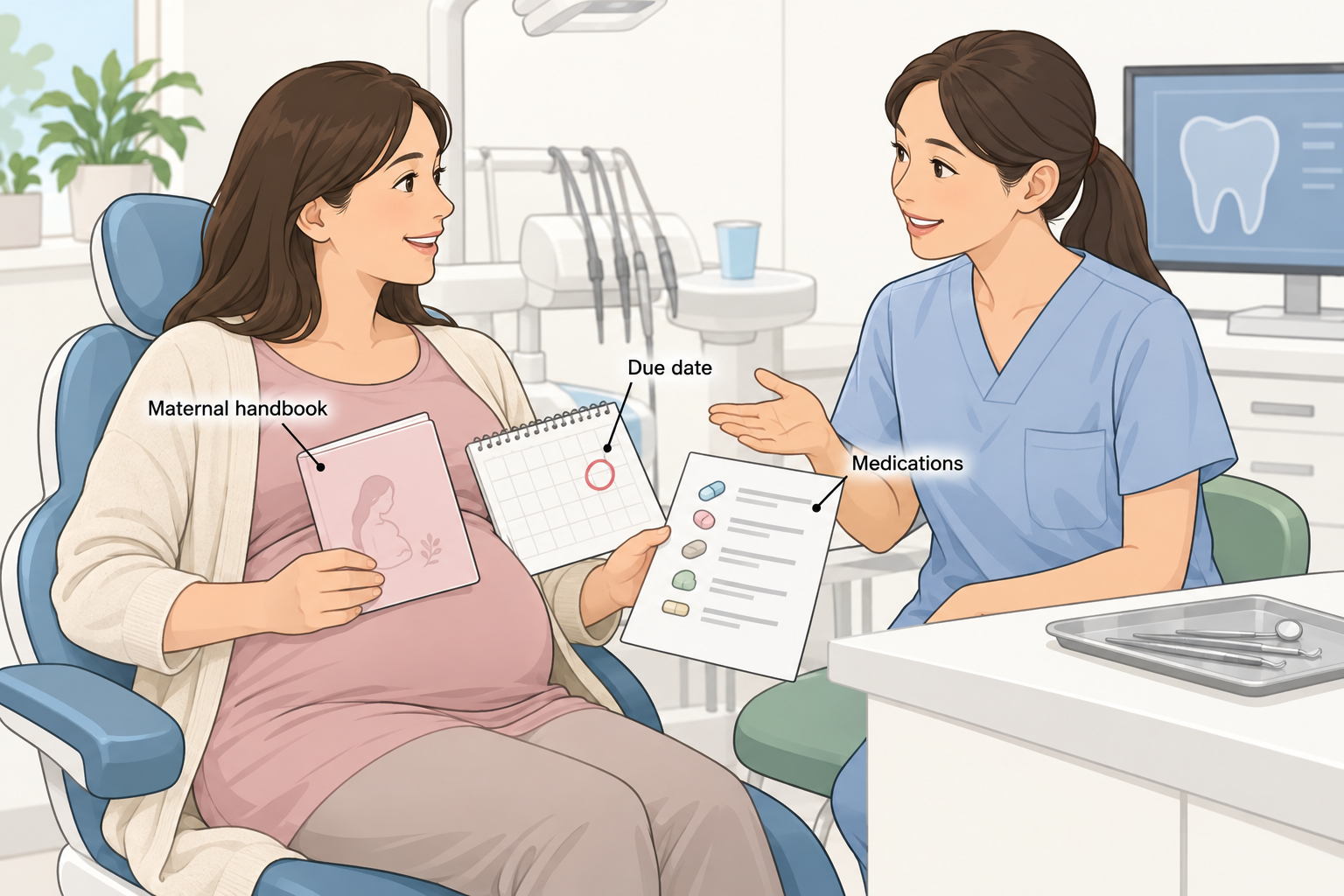
Your Maternal and Child Health Handbook (母子健康手帳) is more than a checkup voucher holder — it's a shared record. Bring it to dental visits so the clinic can note treatment and you can keep everything in one place. Always tell the clinic you're pregnant when you book and again at the chair, along with your due date and any pregnancy complications, since this guides their choices on anesthesia, X-rays and medication. A simple phrase: 妊娠中です (ninshin-chū desu — I'm pregnant), and 妊娠◯ヶ月です to state how many months along. If you're seeing a dentist for the maternity checkup specifically, mention 妊婦歯科健診 (ninpu shika kenshin). Coordinating between your obstetrician and dentist is wise for anything beyond routine care — if in doubt, your OB can advise whether a given dental treatment is fine to proceed with.
Protecting your baby's future teeth
Caring for your own mouth during and after pregnancy benefits your child directly. Cavity-causing bacteria aren't present at birth — they're commonly passed from caregivers to babies later, for example by sharing spoons or tasting food, or blowing on it, with the same utensil. Keeping your own teeth healthy and treating active decay lowers the bacterial load you might transmit. After the birth, simple habits help: avoid sharing eating utensils where practical, don't "clean" a dropped pacifier in your own mouth, and keep up your own checkups. Combined with the infant dental screenings Japan offers at well-child checks, this gives your baby the best start. None of it requires perfection — just awareness that your oral health and your child's are linked.
Bottom line
Pregnancy raises your risk of gum problems and cavities, but Japansupports you with a subsidized maternity dental checkup via the Maternal and Child Health Handbook — available regardless of nationality. Routine treatment is safe, ideally in the second trimester, as long as you tell the clinic you're pregnant. For an English-speaking clinic comfortable with maternity care, a matching service can help.
Frequently Asked Questions
Is there a free dental checkup for pregnant women in Japan?
Most municipalities offer a maternity dental checkup (妊婦歯科健診), included with the vouchers you receive alongside the Maternal and Child Health Handbook when you register your pregnancy. It's available to pregnant residents regardless of nationality and is typically free or low-cost at participating clinics.
Is it safe to go to the dentist while pregnant in Japan?
Yes. Routine dental care — cleanings, exams and necessary treatment — is safe and encouraged, ideally in the second trimester for non-urgent work. Urgent infections or pain should be treated whenever they occur. Always tell the clinic you're pregnant so they adjust anesthesia, X-rays and medication.
Can I get a tooth treated or have an X-ray while pregnant?
Necessary treatment can be done, and X-rays are used only when essential, with abdominal shielding and minimal exposure. Elective procedures like whitening are postponed. Inform the dentist you're pregnant and how far along so they can take the right precautions.
Need an English-speaking dentist? We'll find one — free.
Tell us your area, language, and the treatment you need. We match you with the right clinic and make the booking call for you, in your language.
This article is general information for foreigners living in or visiting Japan, not medical or financial advice. Prices are typical 2025–2026 ranges and vary by clinic, region, and your specific case; insurance coverage depends on your enrollment and the treatment. Always confirm details directly with the clinic.